← Back through the wallThe walk Case Files

Case Files

Real problems. Scripture answers.

A Doctrinal Mastery game for seminary. Students write real problems a teenager could face, then answer each one the way they would answer a friend: the text they would send, built on a passage they know. The class reads it on the wall; nothing is sent.

An engraved plate: sealed scrolls, a magnifying glass, an oil lamp and a quill before the walls of Jerusalem

Try a case

Here is one of the game’s case ideas, with the kind of answer a team writes, and the five passages that team held. Read them, then do what the rest of the room does: guess which passage the team built on.

Case 1
Who
Age 16
What happened
Kids pass a vape around in the school bathroom and keep offering it to him.
What he feels
Awkward. He wants to fit in.
Tempted to
Try it once so they stop asking.
Team 2 would send
You don’t have to try it to belong. Joseph walked out of the room, and you can too. Sit with us at lunch?

Which passage did they build it on?

Watch a round

The Quick look your class can watch in the lobby runs under three minutes. In the game, a six-minute walk-through of every step is one tap away, with Back, Pause and Next.

An engraved seminary classroom before dawn, a television on the far wall

One morning, start to finish

About thirty-five minutes of a fifty-minute class. The pictures below are from test games on the live site, from the moment a case is filed to the moment it comes back to the student who wrote it.

Before class

Open a room. Mirror the wall.

An iPad or laptop shows the wall on the classroom TV, with the code and the music. Your own phone becomes the teacher remote, so you can run every step from where you stand (one tap on the iPad starts the music).

A first game? Open it Guided: every phone opens each step with a short note that says what happens now. For a class that knows the game, choose They know it.

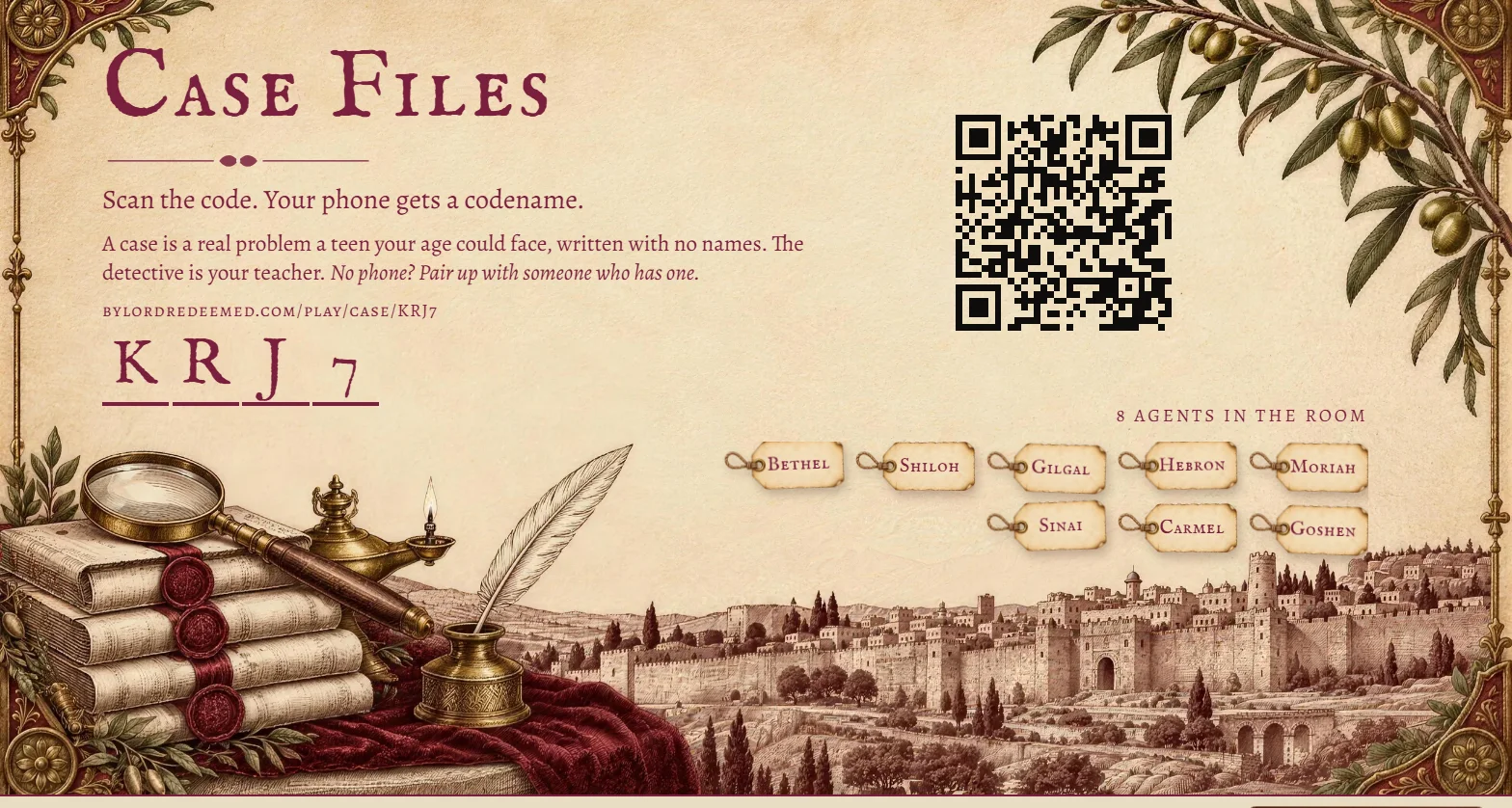
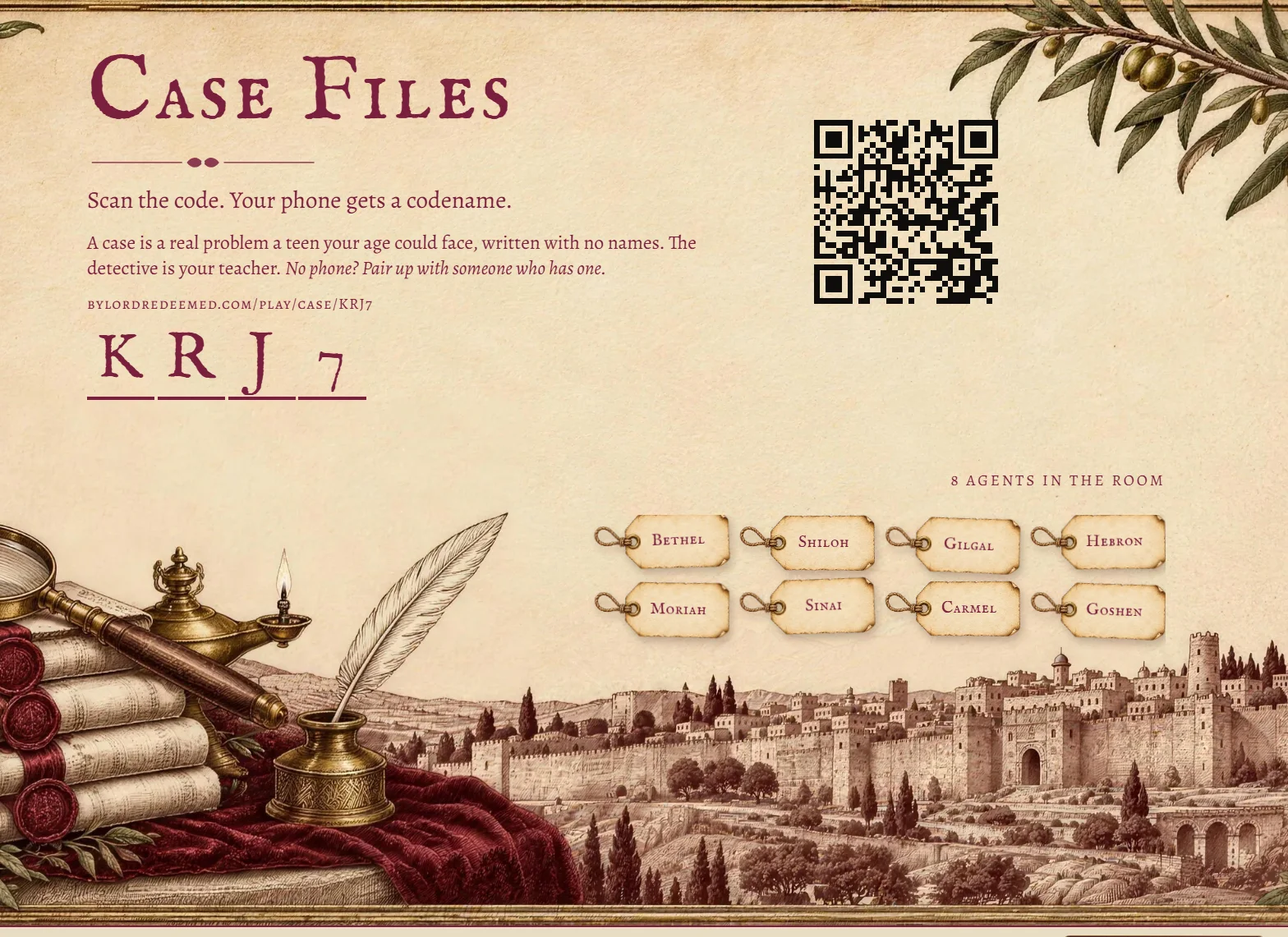
The wall in the lobby: the room code, a QR code, and eight agents in the room
6:00 · Join

Every phone becomes an agent

Students scan the code. No app, no account. Each phone gets a codename from a place in the Old Testament, and that is all the room ever sees.

The one rule. We never guess who wrote a case.

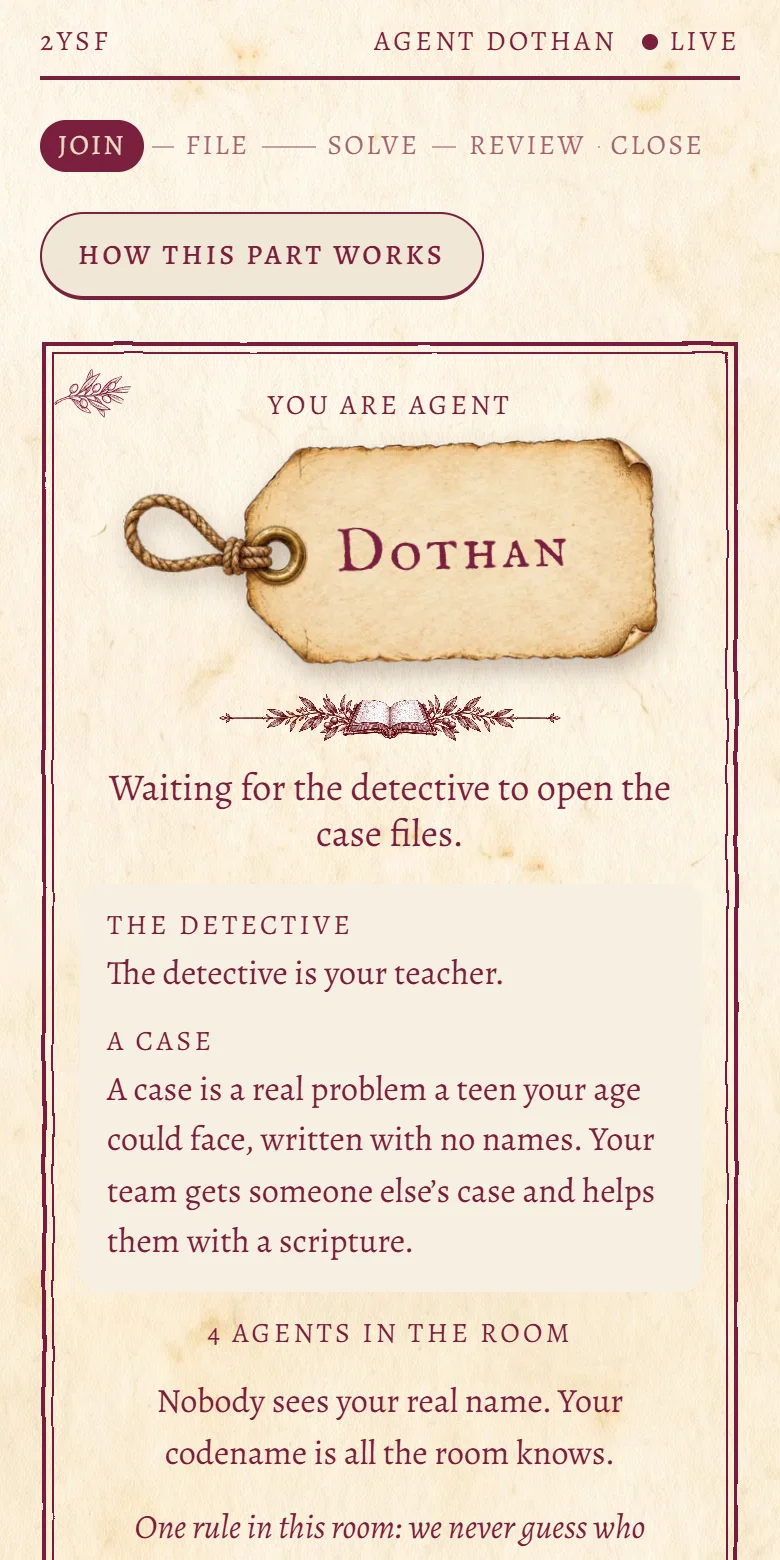
A phone in the lobby, showing the codename Dothan and what the detective and a case are
6:02 · File

Five minutes to file a real problem

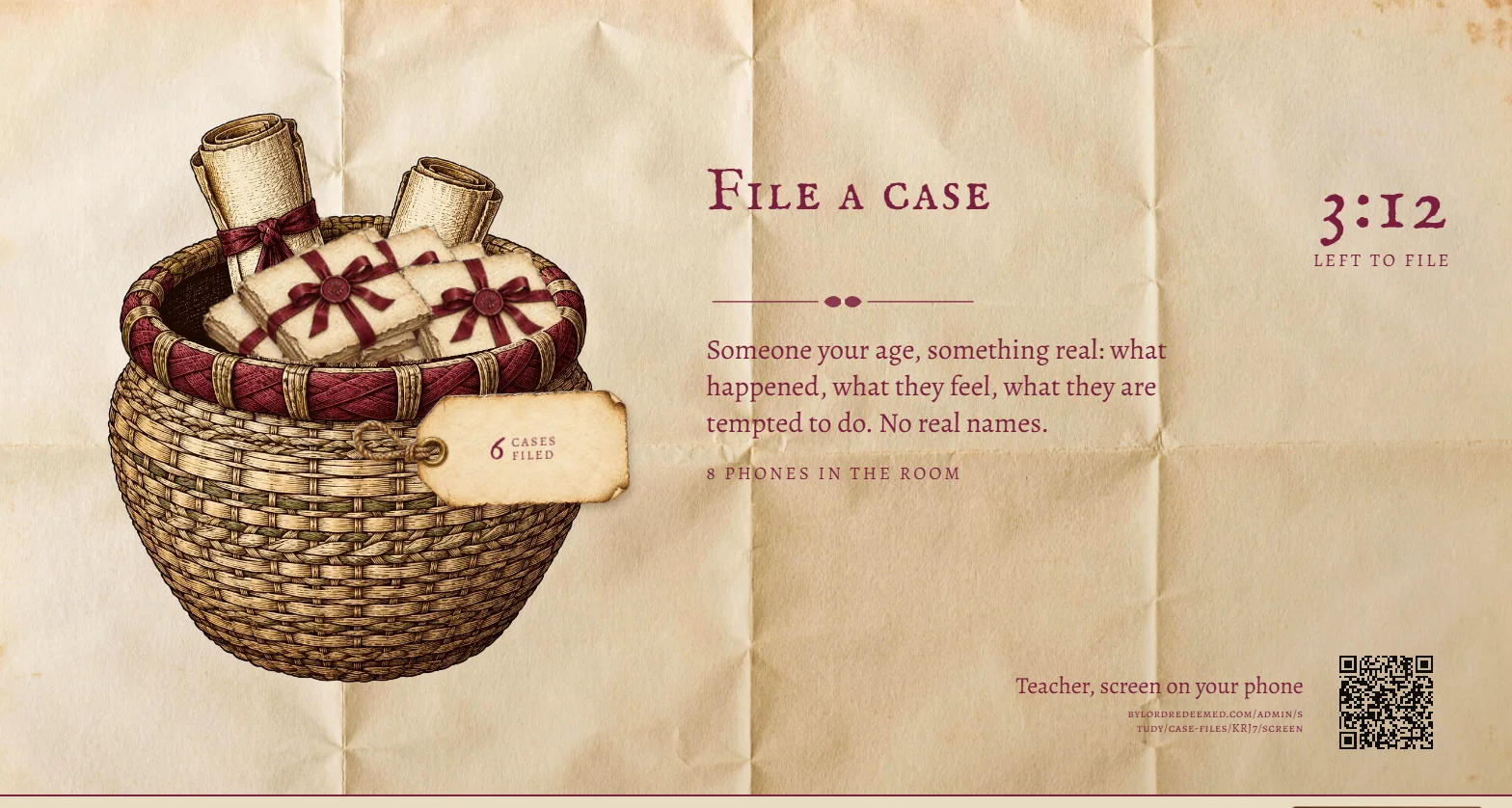
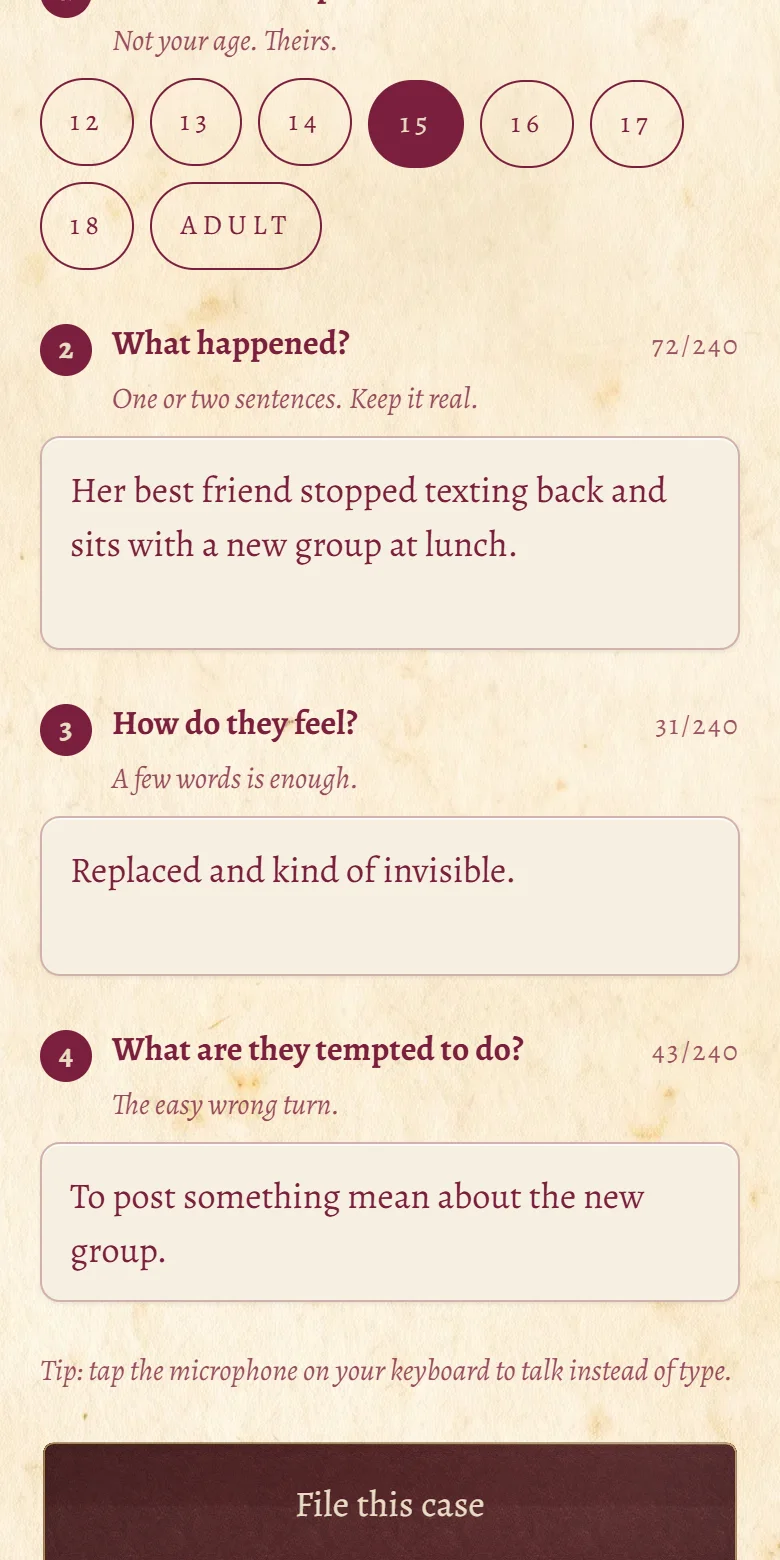
Someone their age: what happened, how they feel, and what they are tempted to do. An age, never a name. The wall counts each case into the basket; nobody sees the words yet.

Stuck? “Need an idea?” offers something to think about first; after a little while, 100 vetted case ideas open. Too few cases? Cold cases fill the gaps.

The wall while cases are filed: the basket and the clock
The filing form with a case typed in
6:07 · Screen

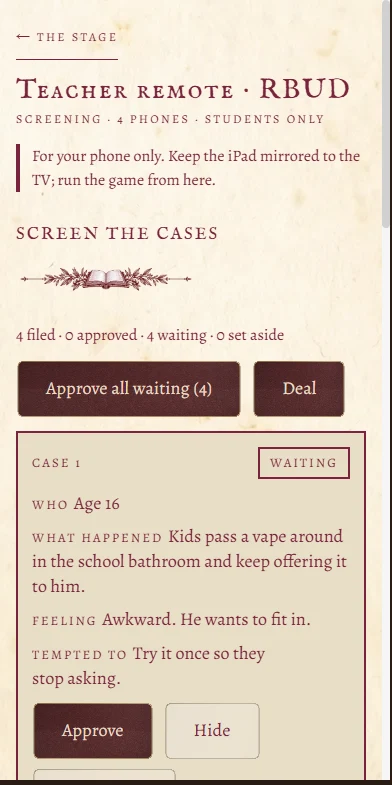
You approve every case first

On your phone, never on the TV. Approve, hide, or flag a case for yourself; read each one, or approve all at once. Nothing a student files reaches the wall until you approve it. Cases that use certain danger, abuse or profane words are set aside for you alone and never dealt. A keyword check can miss things, so read what you approve.

The teacher remote, screening the vape case
6:08 · Deal

Small teams, one case, five passages

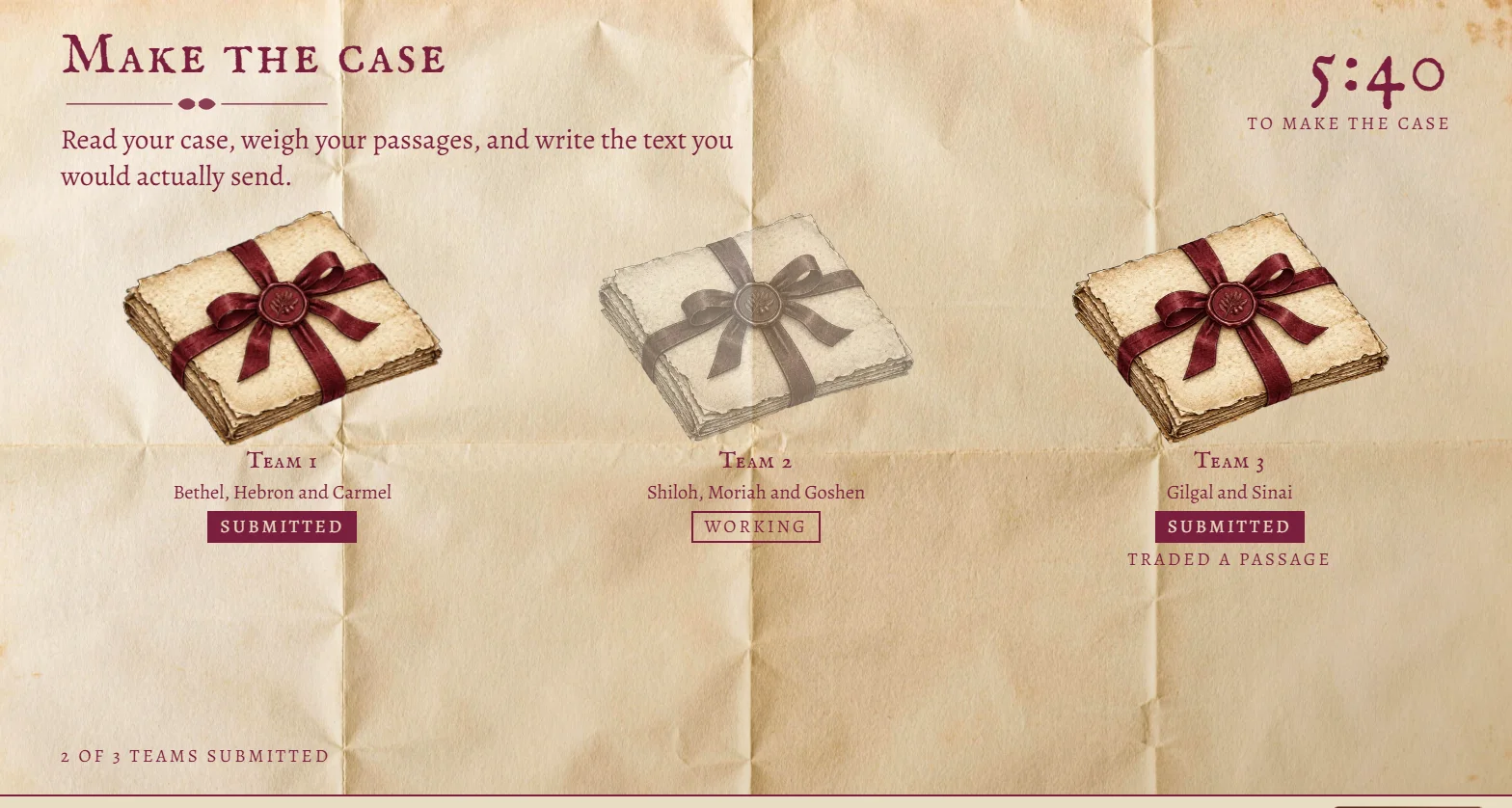
You choose how many teams, up to eight. The game suggests two or three small teams for a class of eight or fewer, and pairs for a larger class; a small class can also play everyone on their own. Each team gets a case none of its own members wrote, and five of the 24 Old Testament Doctrinal Mastery passages, dealt so the teams hold different ones while the deck lasts. Usually at least one plainly fits; the trade and the search are there when none does.

The wall while three teams make their case
6:08 · Solve

Eight minutes, four short steps

A team can name a scribe: one phone writes and seals, while the others search the scriptures and send it ideas. Or skip the scribe, and anyone writes. Read the case. Pick a passage: open the whole verse and its doctrine, trade one once, or search by situation, typos and all, with words from the case one tap away. Write the text you would actually send and, if they like, one line on why it fits and a scripture of their own from any book. Then name the principle it uses and seal it. A clue opens at half time.

Nothing is sent to anyone. The team’s answer goes up on the wall for the class.

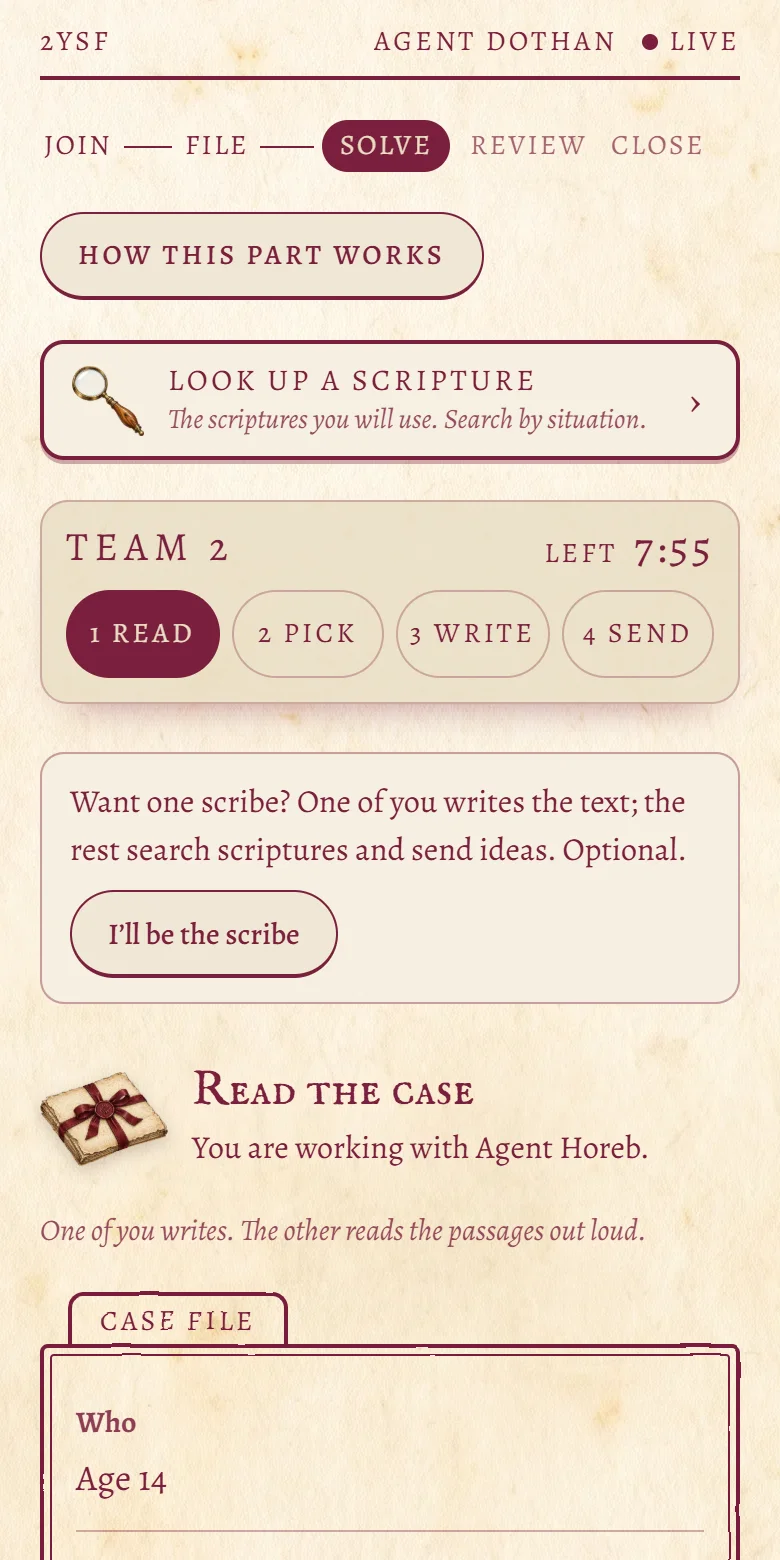
Step 1: read the case; anyone can offer to be the scribe
1 Readthe case
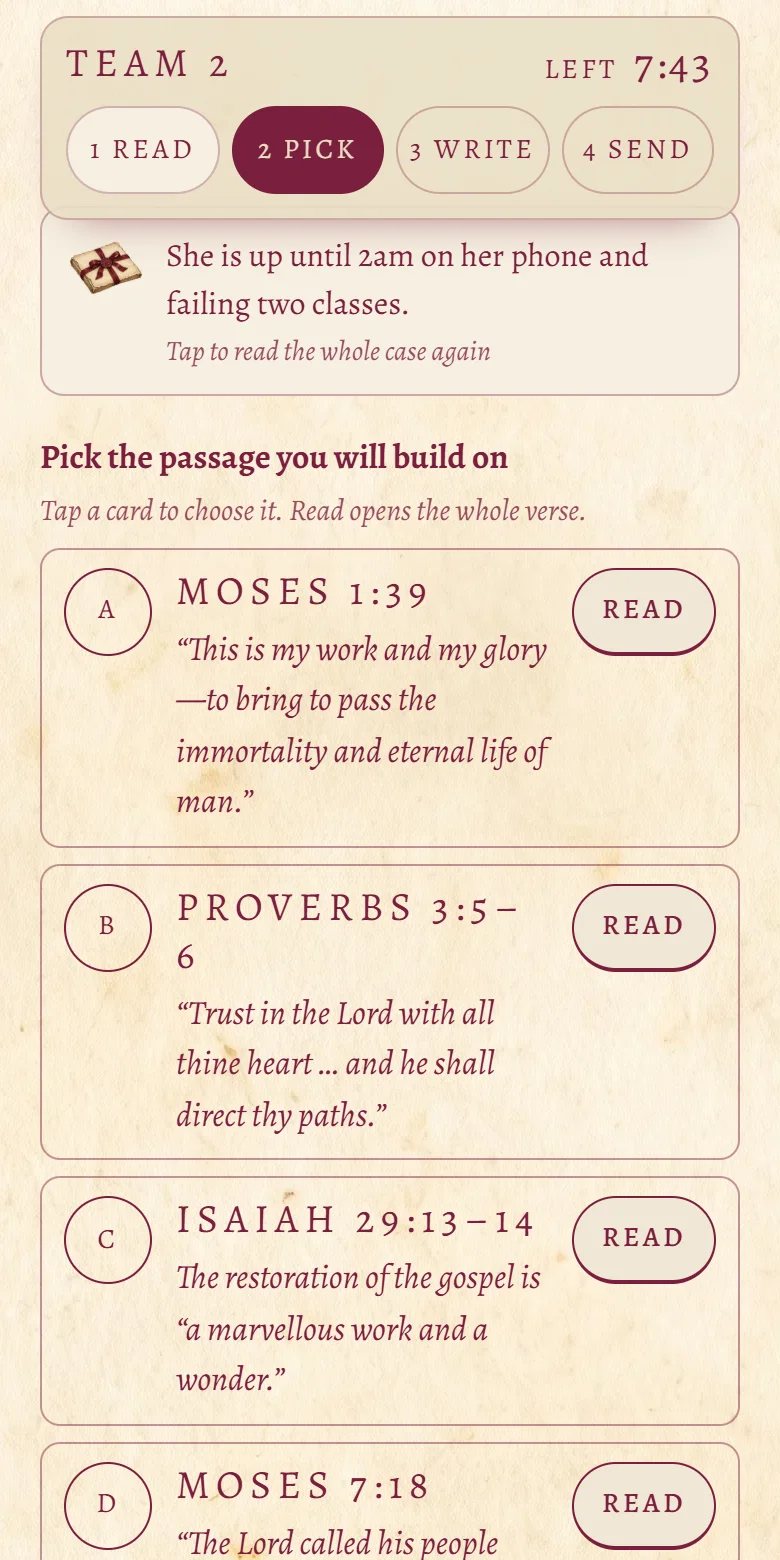
Step 2: five passages; tap one, or read the whole verse
2 Picka passage
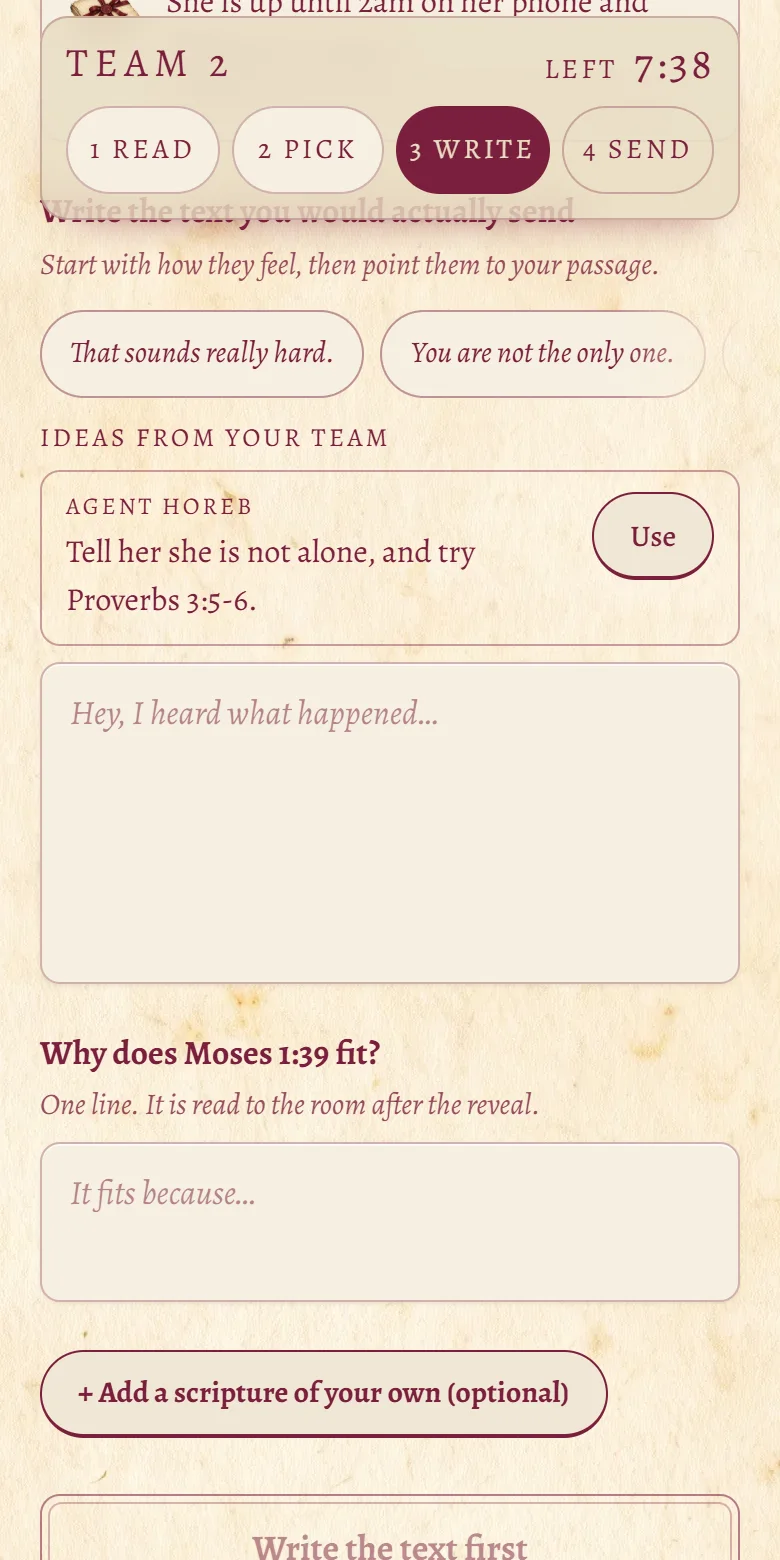
Step 3: the scribe's write step, with a teammate's idea ready to use
3 Writethe text you’d send
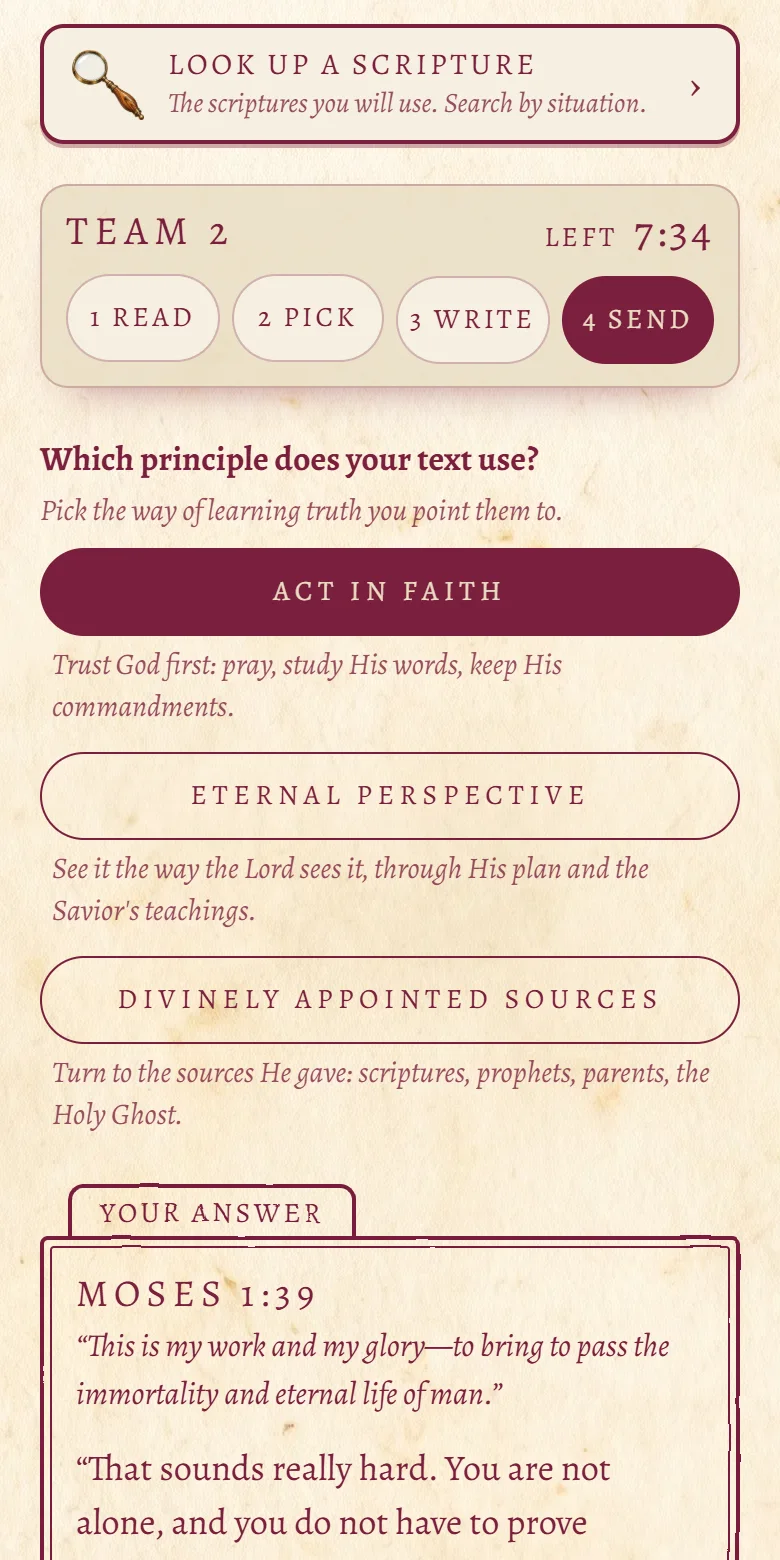
Step 4: name the principle
4 Sendname the principle, seal it
6:16 · Review

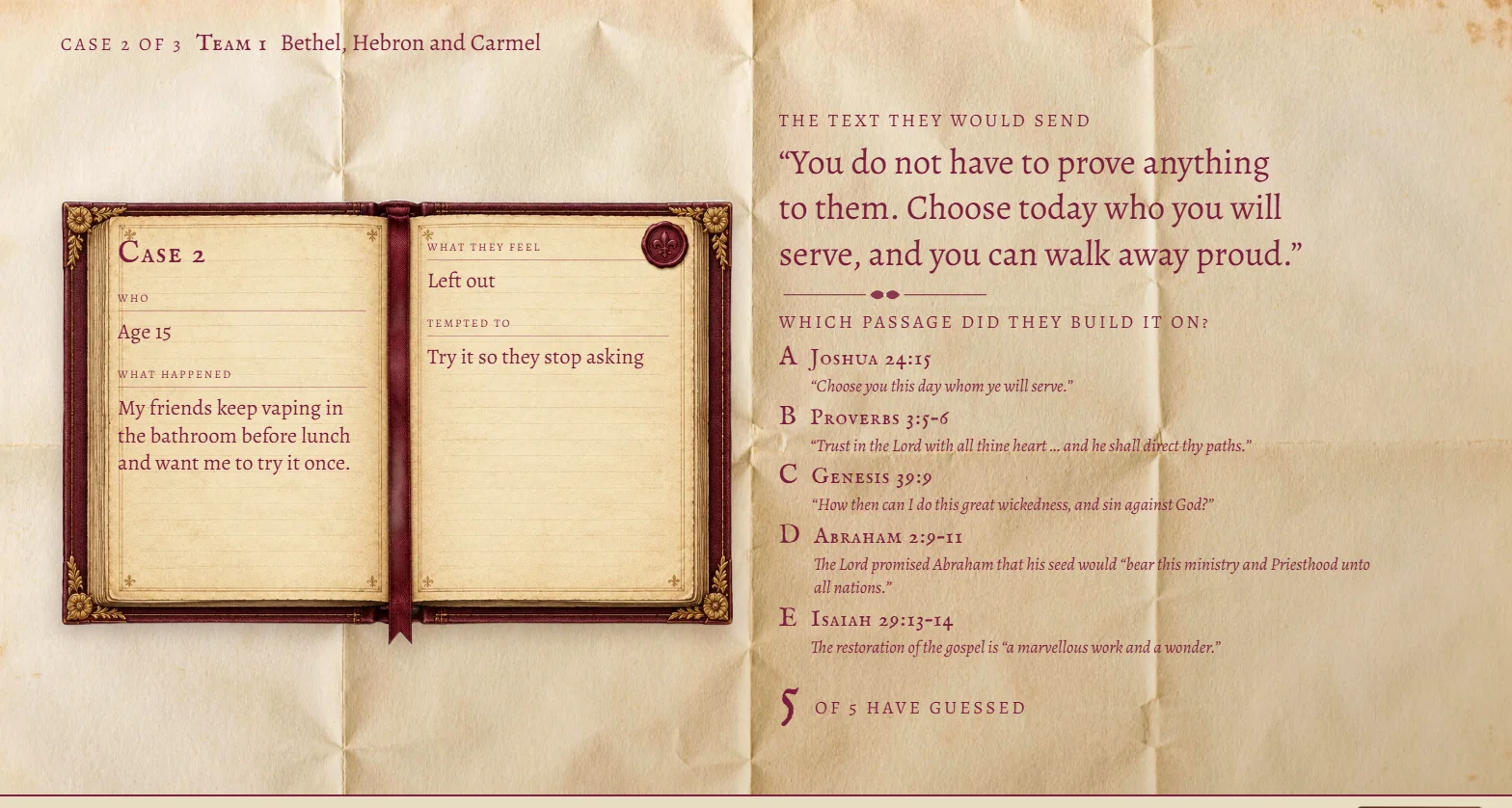
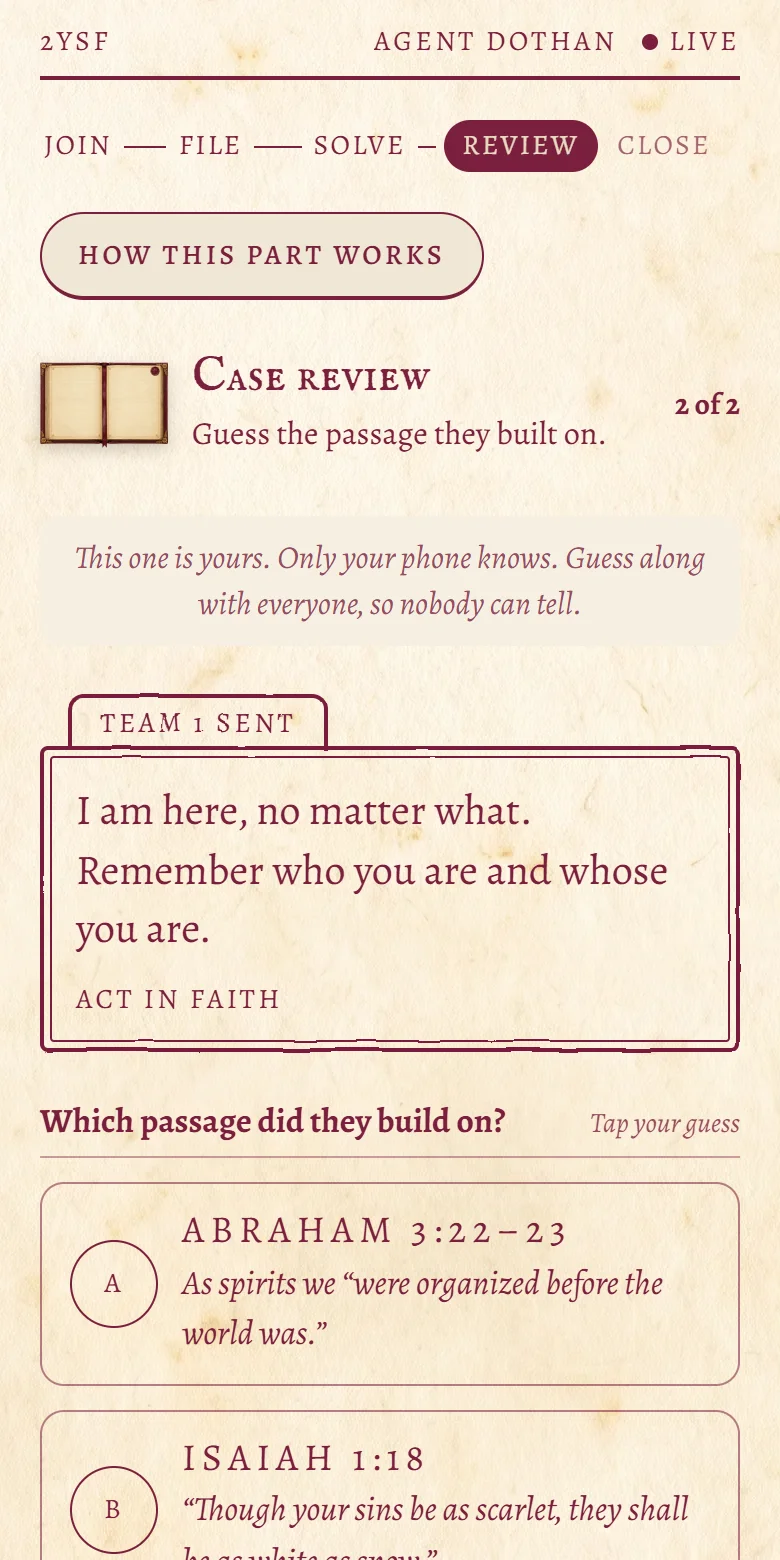
The room guesses the passage

Each case goes up, and a quill writes the team’s text in while the room reads. Everyone else taps the passage they think it was built on, and the wall counts the guesses, so you know when everyone has chosen. Then the reveal, and the team’s why, read to the room.

The wall showing a case, the team's text, five passages to guess, and five of five guesses in
A student's phone: the team's text, with the passages to guess right under it
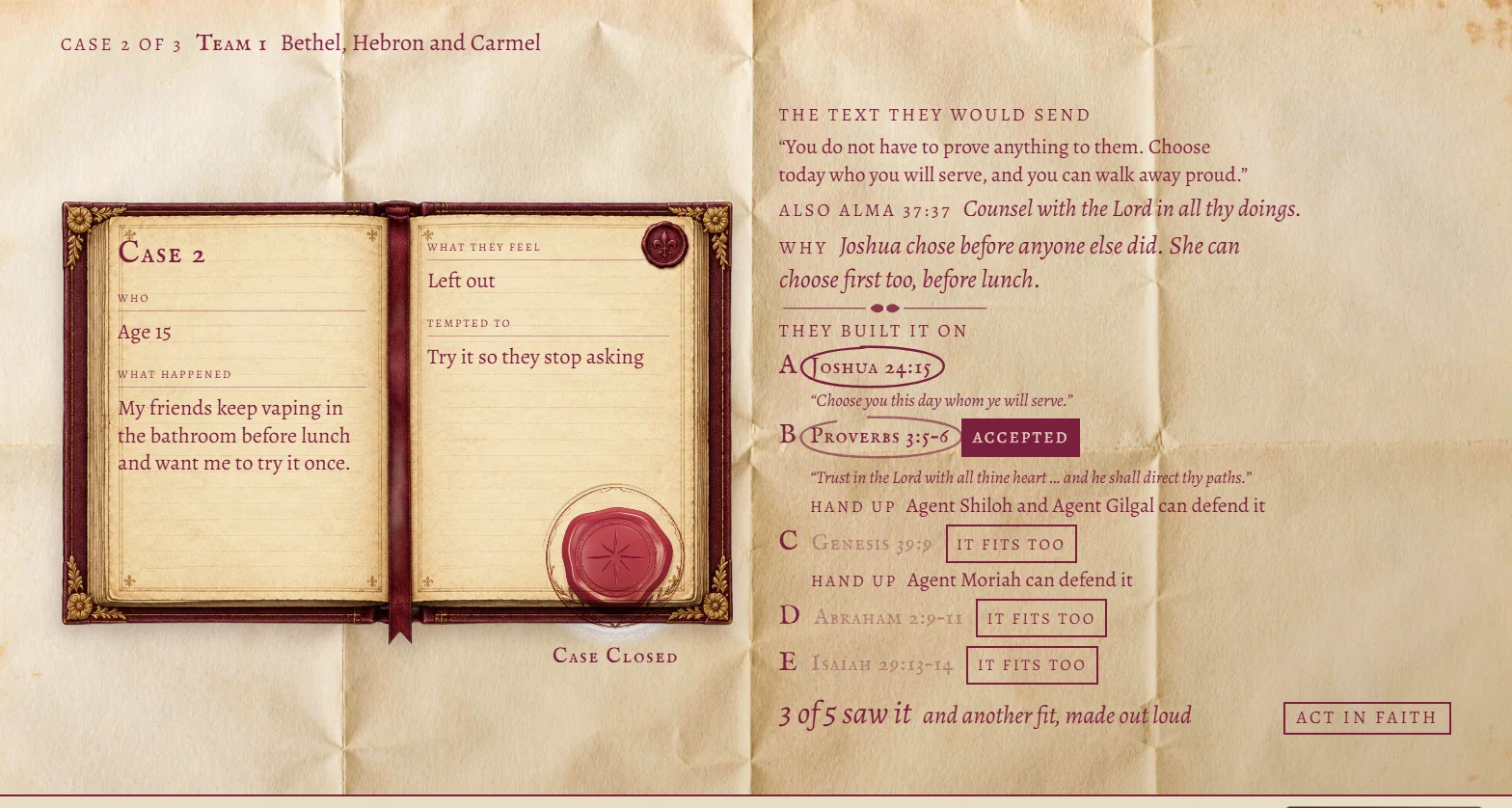
The reveal

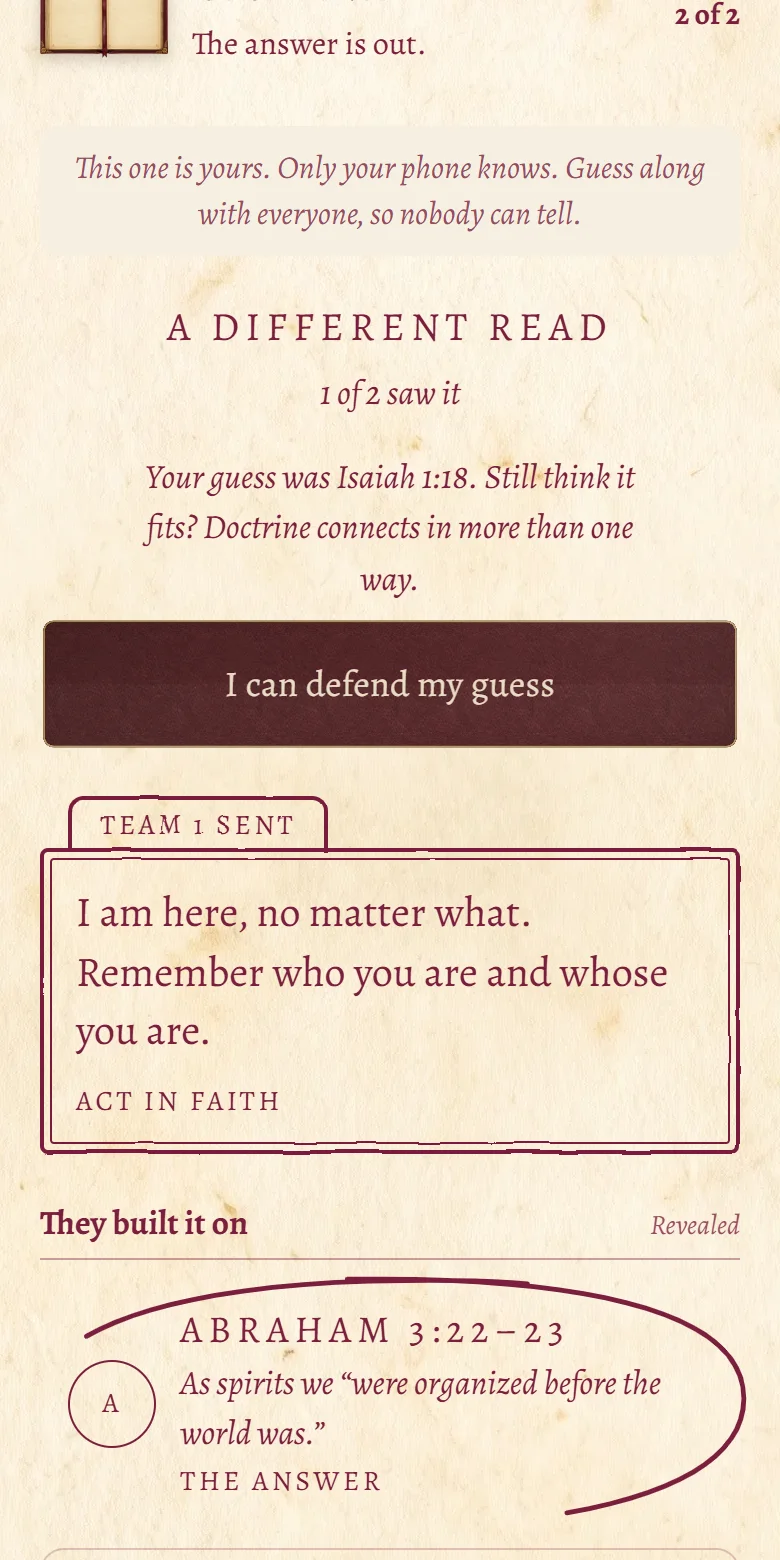
Never wrong. A different read.

A guess that lands somewhere else is a different read. If you can say why your passage fits too, raise your hand on your phone. Your teacher calls on you, and can accept it: it fits too, and you score.

The strongest answers can get the teacher’s Case Closed seal.

The reveal: the answer ringed, the team's why, hands up, another fit accepted, and the Case Closed seal
A different read, with the button I can defend my guess
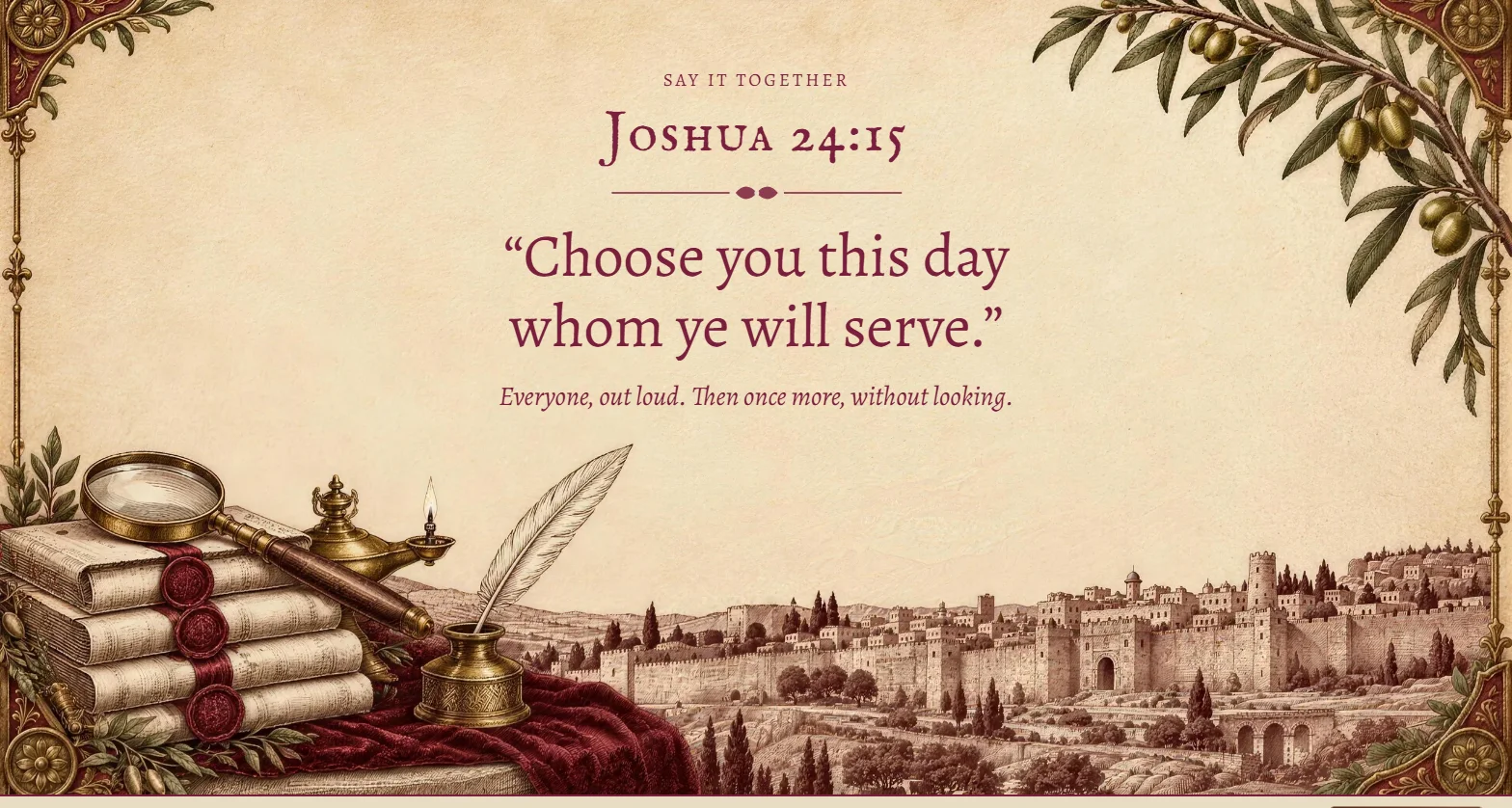
Say it together

Every case closes out loud

The whole class says the passage together, then once more without looking. Then the next case.

Say it together: the passage on the wall
6:29 · Vote

The room votes

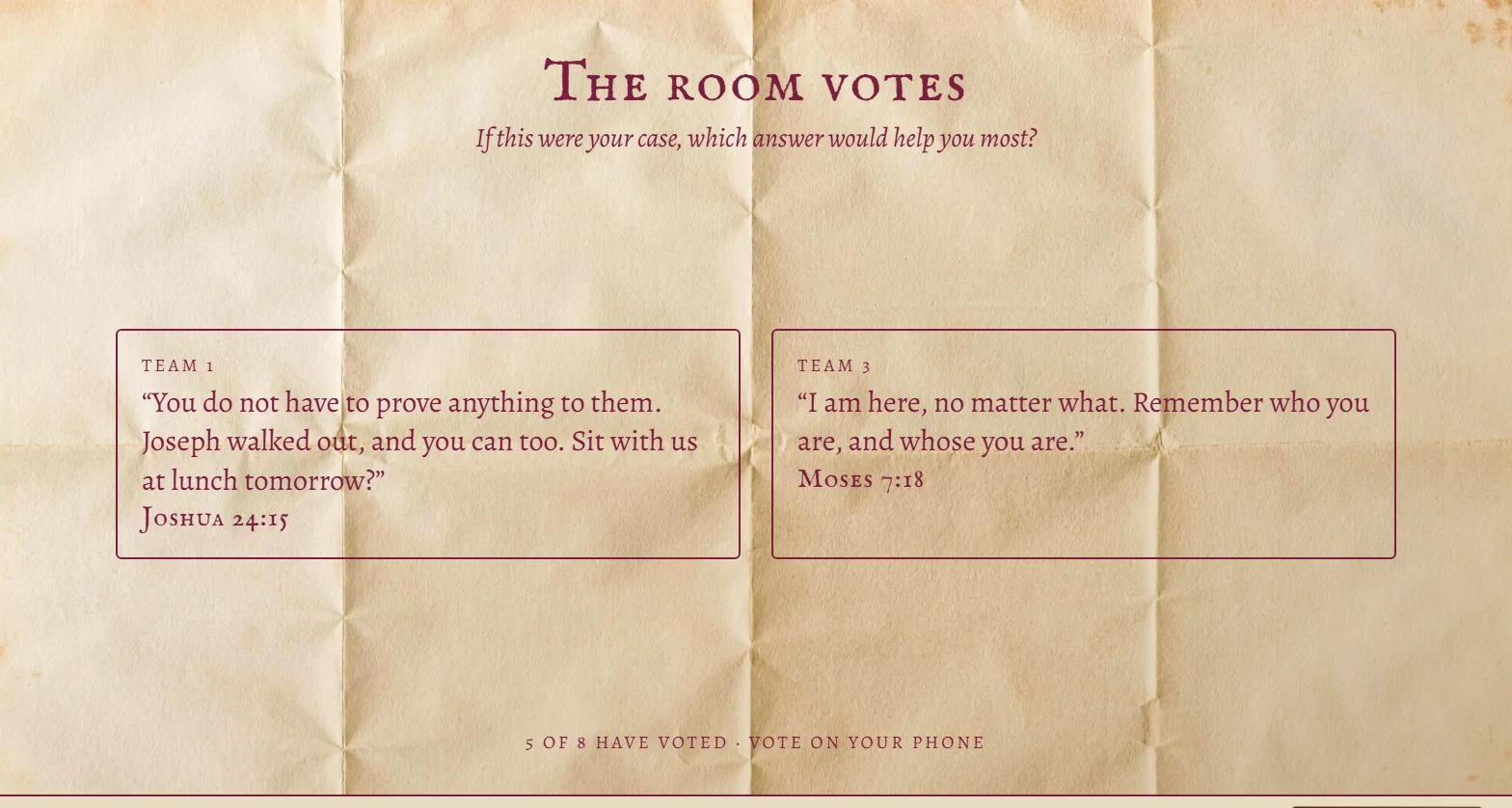
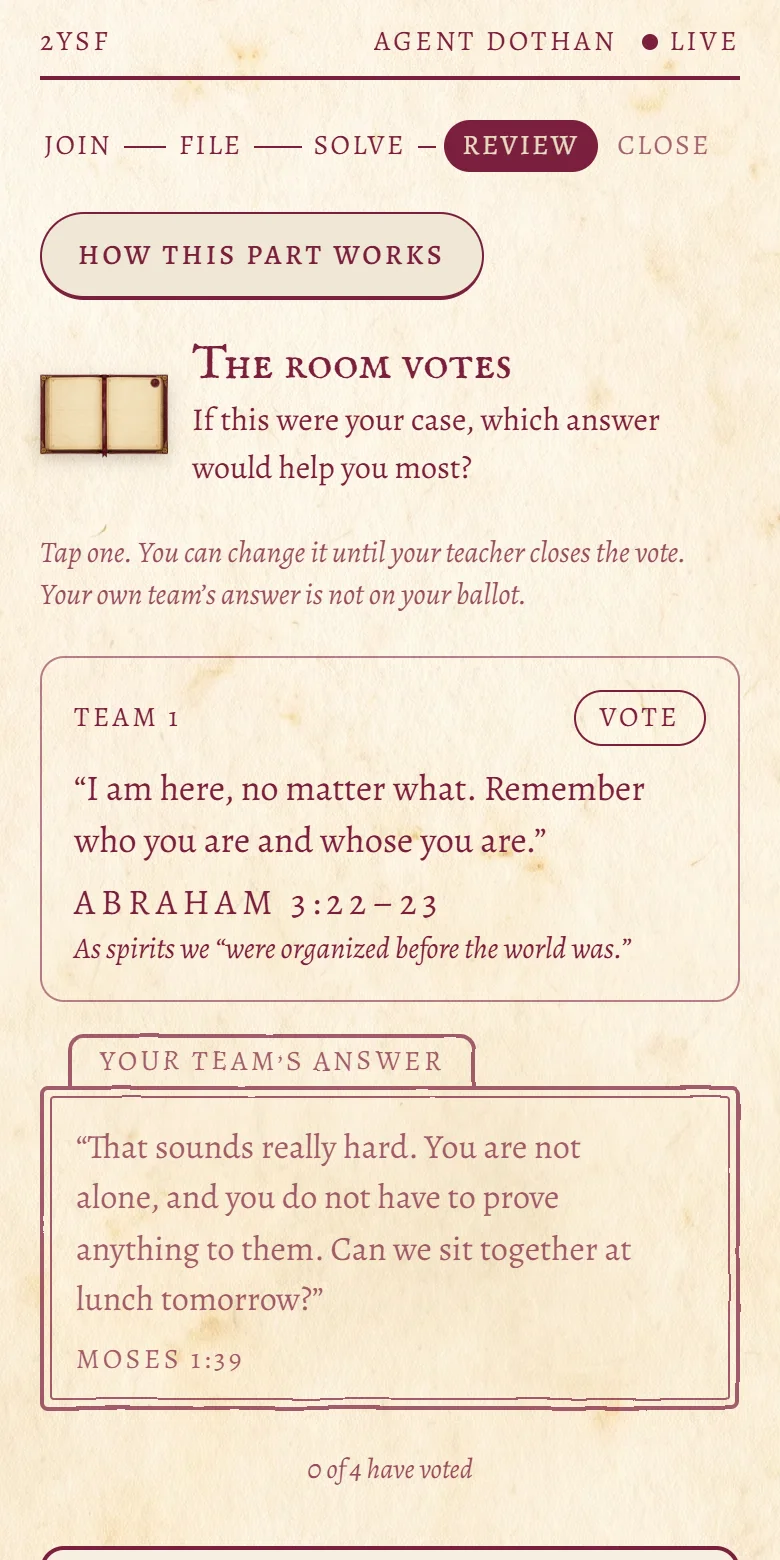
After the last case, when two or more teams sent an answer, every phone sees those answers and votes for the one that would help most if it were their own case, never their own team’s. The wall shows the answers and how many have voted, never who voted for what. The answer with the most votes is the room’s choice; a tie shares it.

The wall while the room votes: two teams' answers and how many have voted
A phone voting for another team's answer
6:31 · Close

A podium, a case answered, a quiet minute

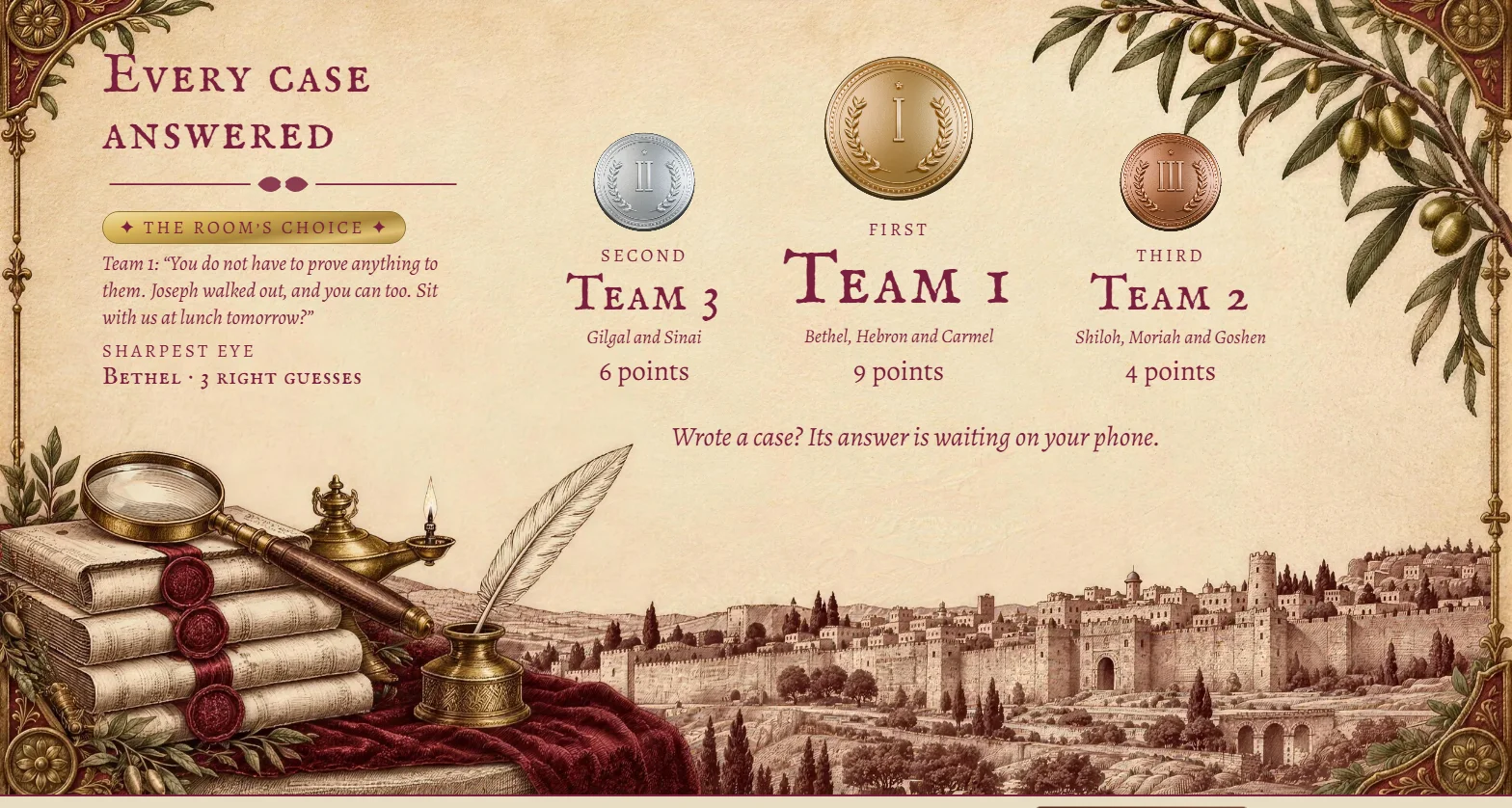
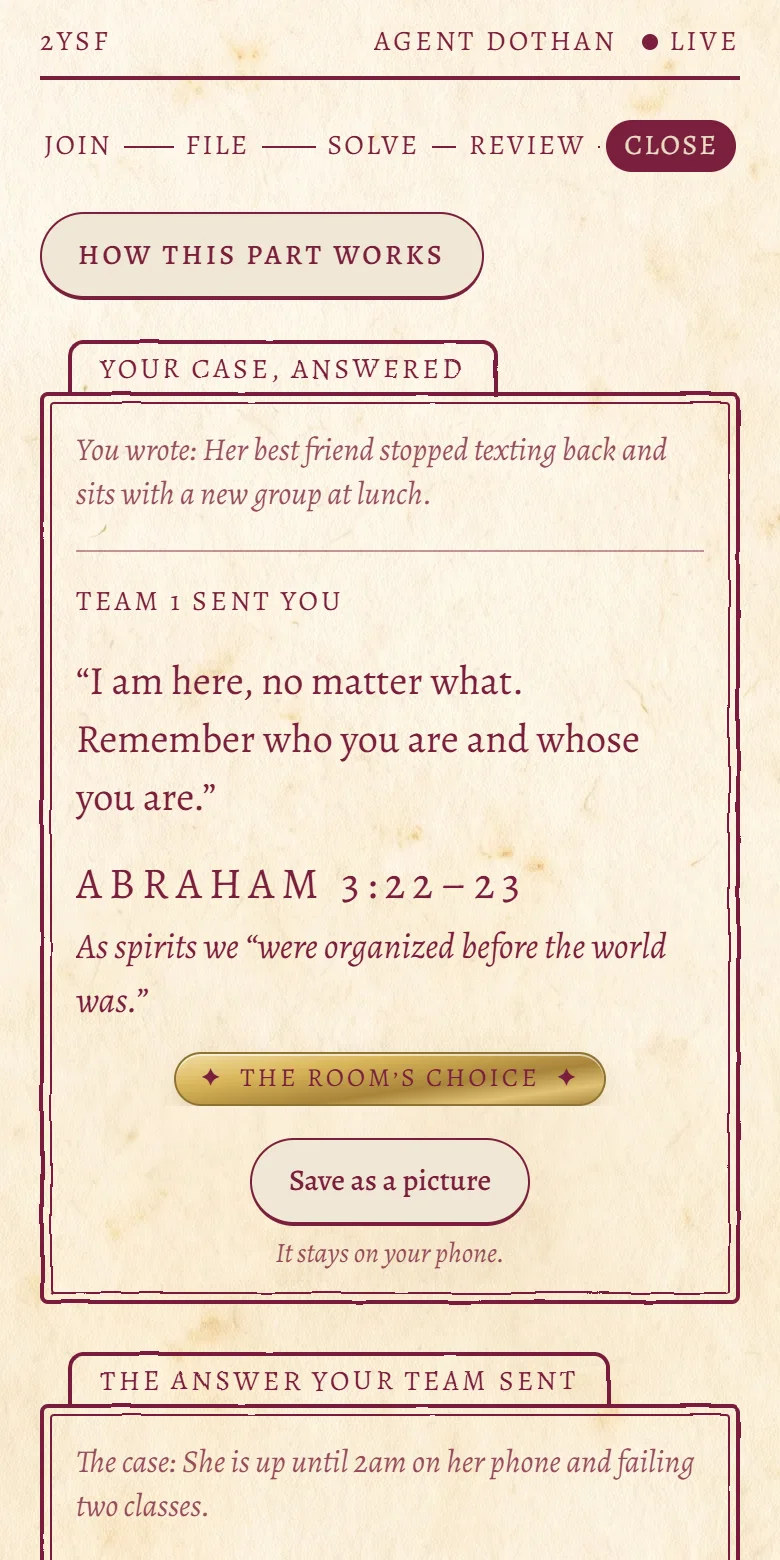
Teams stand on the podium; the room’s choice wears gold, and the sharpest guesser is named. A student whose case was answered gets it back on their phone, written in by a quill: their case, answered, with the scripture it stands on, to save as a picture. Then the music softens, each student picks one passage to carry into the week (only their own phone knows which), and the wall goes still for your witness.

Then it is gone. The words of every case, answer and team idea a student wrote are erased from the game when you close the room, or within a day and a half at most if you forget. A case set aside for you stays until you clear it. A picture a student saved stays on their own phone.

The team podium: the room's choice in gold and the sharpest guesser named
A student's phone: their case, answered, written in by a quill, ready to save as a picture

The rules on three cards

The round

  1. Join with the code: a codename, no names.
  2. File a real problem in five minutes.
  3. Screen. The teacher approves every case.
  4. Deal. A case none of your team wrote, five passages.
  5. Solve in eight minutes: read, pick, write, send. A scribe if you want one.
  6. Review. Guess, reveal, defend, say it together.
  7. Vote. The room picks the answer that helps most.
  8. Close. Podium, your case answered, carry one passage.

Every answer names a principle

Act in faithTrust God first: pray, study His words, keep His commandments.
Eternal perspectiveSee it the way the Lord sees it, through His plan and the Savior’s teachings.
Divinely appointed sourcesScriptures, prophets, parents, the Holy Ghost.

Scoring

Your team scores
+1each classmate who guesses your scripture
+3the room’s choice
+3the Case Closed seal
You score
+1each right guess or accepted fit (+1 if you defended it)

Top team wins. Sharpest guesser named.

The answer is shown to the class, never sent to anyone.

Mastery is knowing what to do with a verse

Doctrinal Mastery asks students to know each passage, understand the doctrine it teaches, and apply it to real questions and situations. Case Files is practice for the last of the three: a real person, a real problem, and the words you would choose.

Knowthe reference and the key phrase
Understandthe doctrine it teaches
Applyto a person, a problem, and the words you would choose. Case Files lives here.

What you need on the morning

Nothing to install, and no student accounts.

An engraved desk from above: a tablet, a phone, a fan of passage cards, a wax seal, a quill and a codename tag
A screen the class can seeAn iPad or laptop mirrored to the TV runs the wall, with music.
Your phone, the remoteScreen the cases, keep the answer key, run every step.
Their phonesTwo to thirty. No phone? Two students can share one.
The passagesThe 24 Old Testament Doctrinal Mastery passages. Choose the ones you have taught, or all 24.

Built for teenagers at six in the morning

Codenames, not namesA codename on every phone, and an age instead of a name on every case.
You approve every case firstNothing a student files reaches the wall until you approve it on your phone. Team answers are not screened. Each team’s text goes up on the wall as written when its case comes up, and again in the vote; its why and any scripture of its own go up at the reveal. You can read each team’s text on your phone as soon as it is sent.
A cry for help comes to youCases with certain danger or abuse words are set aside for the teacher alone, never dealt, and kept for your follow-up. A keyword check can miss things.
Erased at the endEvery case, answer and team idea a student wrote is cleared when you close the room. Anything you flagged stays, for you. A picture a student saves stays on their own phone.

Questions teachers ask

Do students need an app or an account?

No. They scan the code on the wall, and their phone gets a codename. Nothing to install.

Do I need an account?

Students never do. Teachers need a login, and teacher access is not open yet. Fill in the card and you will hear back.

How long does it take?

Plan on about thirty-five minutes: five to file, a minute to screen, eight to solve, then the reviews, a minute to vote and a quiet close. On a short morning, “Skip this case” and “Straight to the podium” are there; going straight to the podium skips the vote.

How many students can play?

Two to thirty phones. You choose the number of teams: the game suggests two or three small teams for a class of eight or fewer, and a small class can play everyone on their own.

Is anything sent to anyone?

No. The text a team writes is shown on the wall for the class to read and guess. Nothing is texted to anyone.

What if a student writes something serious?

A case that uses certain danger or abuse words is set aside for the teacher alone and never dealt. It stays after the room closes so you can follow up the same day. The check looks for words, so it can miss a case put another way: read what you approve.

What if my class has never played?

Open the room Guided. Every phone opens each step with a short note that says what happens now, and the “How it works” film is one tap away in the lobby.

Which passages are used?

The 24 Old Testament Doctrinal Mastery passages. Choose the ones you have taught, or all 24.

Teach seminary? Request a room.

Case Files was made for one early-morning seminary class. If you would like to play it with yours, fill in the card.

Your card goes by email to the teacher who made Case Files.

Sealed

Your card is on its way. A reply will come to the email you gave.

An engraved plate of Jerusalem at dawn, an open book and a quill

Somebody out there has a case like this one

Go be the answer.